
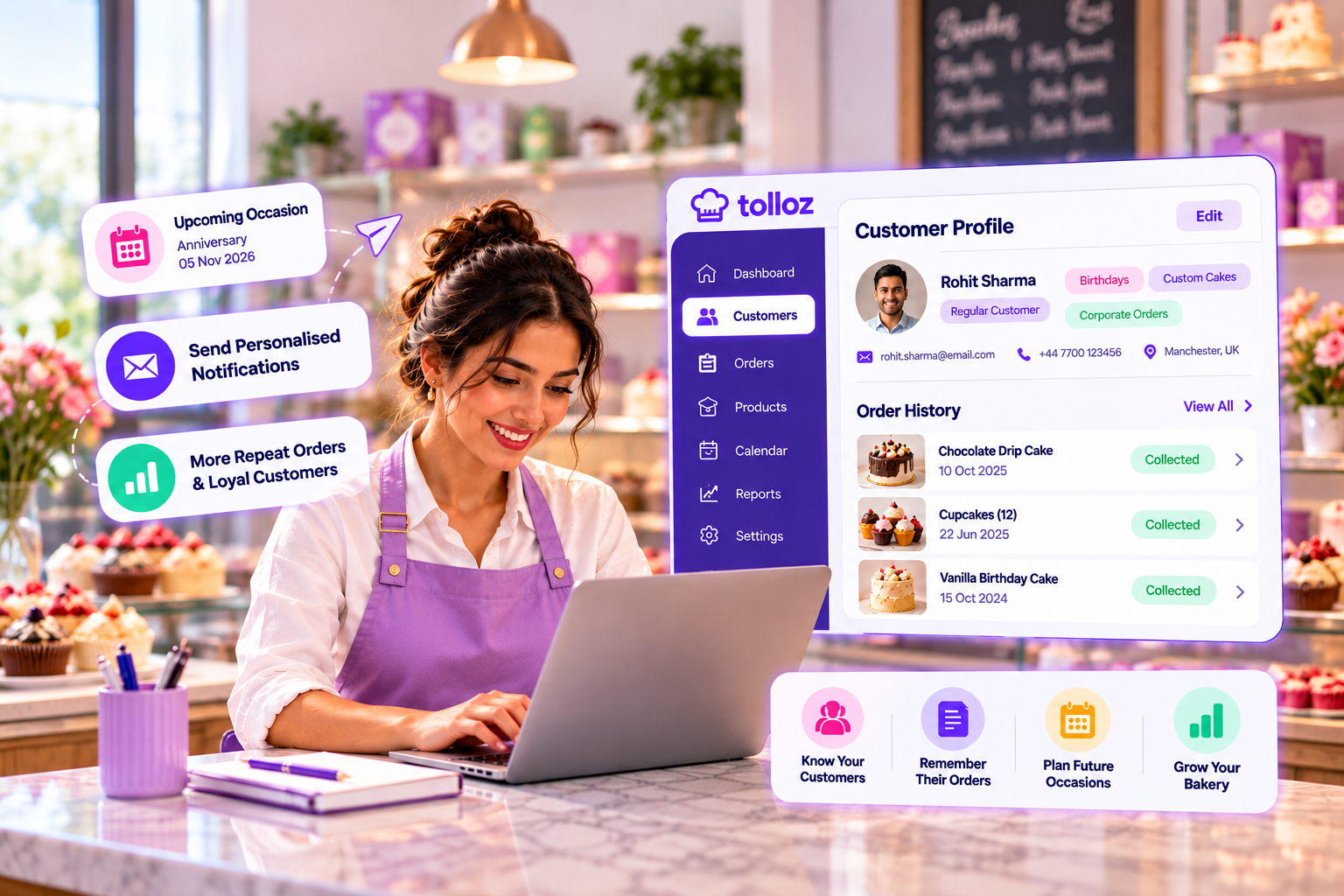
Learn how customer order history helps bakeries understand buying habits, personalise service, encourage repeat orders and grow customer loyalty.
A customer orders a birthday cake from your bakery. You take their requirements, prepare the cake, arrange a collection and complete the sale. A few weeks later, another customer places an order. Then another. But what happens to the information from those previous orders?
If it stays in a paper order book, an old WhatsApp conversation or a spreadsheet that nobody checks, you could be missing valuable opportunities. You may not remember a customer's favourite flavour, the size of their usual birthday cake or when they are likely to need another celebration cake.
Every order tells you something about the person who placed it. When you keep that information organised and use it thoughtfully, you can provide a more personal experience, make repeat ordering easier and build stronger customer relationships.
This is where bakery customer management software can make a real difference. It helps you connect customer details with their previous purchases, preferences and important occasions, giving you a clearer picture of the people behind your sales. In this guide, we will explore how to use customer order history to understand your customers, improve your service and create more opportunities for your bakery to grow.
Why Customer Order History Matters More Than You Think
Running a bakery involves much more than producing delicious cakes and pastries. You also need to manage enquiries, understand customer requirements, coordinate collections, track payments and maintain relationships after each sale. For many independent bakeries, customer information is collected every day but rarely used beyond completing the current order.
Consider a customer who orders a chocolate birthday cake every year. If you have their previous order details, you may already know their preferred size, flavour, design style and collection requirements.
Without an organised record, your team might need to ask all the same questions again. With a customer history, you can make the next conversation quicker and more personal. It also helps you recognise buying patterns. For example, a customer who orders cupcakes for office celebrations may be interested in larger party orders. Someone who regularly purchases celebration cakes may return for anniversaries, family birthdays and other milestones. The important point is that customer order history is not simply a record of completed sales. It is a source of useful information that can help you make better business decisions.
What Is Bakery Customer Management Software?
Bakery customer management software is a digital system that helps bakeries organise customer information, previous orders, preferences and communication in one place. Unlike a basic contact list, it connects customer details with the products and services they have purchased. This gives your team more context whenever a returning customer contacts the bakery.
Depending on the platform, customer records may include:
Customer name, email address and telephone number.
Previous cake and bakery orders.
Cake flavours, sizes, fillings and design preferences.
Reference images and special instructions associated with orders.
Order values, deposits and outstanding balances.
Collection dates and order status.
Important occasions such as birthdays and anniversaries.
For a bakery, this information is particularly useful because many purchases are linked to personal events. Customers may order weeks in advance, request specific designs and return for similar occasions every year. A connected system makes it easier to retrieve this information without searching through several different tools.
For example, Tolloz brings bakery EPOS, CRM and order management together in one cloud-based platform. Its customer CRM and order history help bakeries keep customer details and previous orders organised alongside their everyday bakery operations.
The Problems Caused by Disconnected Customer Records
Many bakeries start with simple processes. A notebook, spreadsheet or WhatsApp account may be enough when order volumes are low. However, as the business grows, those methods can become difficult to manage.
1. Important customer information gets lost
A customer may share their cake design through WhatsApp, confirm the flavour over the phone and pay a deposit in the shop. When these details are stored separately, staff may struggle to find the complete order history later. This can lead to repeated questions, missing instructions and unnecessary delays.
2. Returning customers have to explain everything again
Imagine a regular customer who has ordered the same chocolate cake for three consecutive birthdays. When they return, they expect the bakery to have some understanding of their previous requirements. If your team cannot find the old order, the customer has to explain everything again. Remembering small details can make a significant difference to the customer experience.
3. Repeat sales opportunities are overlooked
A completed order does not necessarily mean the customer relationship has ended. A birthday cake customer may return for an anniversary, a wedding celebration or another family event. However, if you do not maintain useful customer records, you may not recognise the opportunity to reconnect.
4. Staff spend too much time searching
When several employees take orders, customer information can become scattered across individual notebooks, phones and spreadsheets. Instead of helping customers, staff spend time searching for previous orders and confirming details with colleagues. A central customer record reduces this unnecessary administration.
5. Marketing becomes too generic
Sending the same promotion to every customer may not be relevant to their interests. A customer who regularly orders children's birthday cakes may respond to a birthday related offer. Someone who orders corporate cupcakes may be more interested in office catering options. Understanding previous purchases gives you a better starting point for relevant communication.
7 Practical Ways to Use Customer Order History to Grow Your Bakery
Collecting customer information is only the first step. The real value comes from using it to improve service and make better business decisions. Here are seven practical ways to turn order history into business opportunities.
1. Make Repeat Orders Easier
One of the simplest ways to use customer history is to make the next purchase more convenient. Think about a customer who ordered a two-tier vanilla cake with strawberry filling for a birthday last year. When they contact you again, you can refer to the previous order and ask whether they would like something similar. You do not need to start the conversation from scratch.
You could say:
"Last time, you ordered a two-tier vanilla cake with strawberry filling. Would you like to keep the same flavour this year, or would you prefer something different?" This shows that you value the customer's time and remember their preferences. It also gives the customer an opportunity to update their requirements rather than repeat the entire process.
Business benefit: A smoother repeat-order experience can reduce enquiry time and make it easier for existing customers to purchase again.
2. Remember Customer Preferences
Not every customer wants the same type of cake. Some prefer chocolate, while others choose vanilla, red velvet or fruit-based flavours. Some customers regularly request floral decorations, while others prefer simple designs. Recording these preferences alongside previous orders helps your team understand what individual customers like.
For example:
| Customer | Previous order | Preference | Possible next opportunity |
|---|---|---|---|
| Customer A | Chocolate birthday cake | Chocolate sponge, less sweet filling | Next birthday cake |
| Customer B | Cupcakes for an office event | Mixed flavours | Corporate celebration |
| Customer C | Floral anniversary cake | Pastel colours, fresh flowers | Wedding anniversary |
| Customer D | Children's birthday cake | Cartoon inspired design | Next family celebration |
These records do not need to become complicated. Even a few useful details can help staff provide a more personal service.
Business benefit: Better understanding of customer preferences can improve recommendations and make the buying experience feel more personal.
3. Identify Upcoming Birthdays and Anniversaries
Celebrations create natural opportunities for customers to return to a bakery. A customer who orders a birthday cake this year may need another one next year. Wedding anniversaries, family birthdays, graduations and other milestones can also lead to future purchases. However, customers are busy. They may forget to place an order until a few days before the event. Keeping important occasions in customer records gives your bakery a reason to reconnect at an appropriate time.
For example, you could send a friendly message before a customer's birthday:
"Hi Emily, we hope you are doing well. Your birthday is coming up soon, so we wanted to check whether you are planning a celebration this year. We would be happy to help with your cake order." The message does not need to be a discount promotion. A thoughtful reminder can be enough to bring your bakery back to the customer's attention. Make sure customers understand how their information will be used and that you have the appropriate permission or lawful basis before sending marketing messages.
Business benefit: Occasion based communication can help your bakery identify timely repeat-order opportunities instead of relying entirely on customers to remember you.
4. Recognise Your Most Valuable Customers
Not all customers purchase at the same frequency or spend the same amount. Some may place one small order each year, while others regularly purchase cakes for family celebrations, business events and special occasions. Your order history can help you recognise these differences.
For example, consider the following fictional customer records:
| Customer | Orders in 12 months | Average order value | Total spend |
|---|---|---|---|
| Customer A | 5 | £65 | £325 |
| Customer B | 2 | £45 | £90 |
| Customer C | 8 | £35 | £280 |
Customer A has the highest total spend, while Customer C orders most frequently. Both relationships are valuable, but they may require different approaches. You could thank regular customers, offer early access to seasonal collections or provide a personal recommendation based on their previous purchases. Avoid assuming that the customer who spends the most is always the most loyal. Frequency, recency, order value and customer satisfaction all provide useful context.
Business benefit: Understanding customer value helps you make more informed decisions about retention, service and promotional activity.
5. Recommend Products Based on Previous Purchases
Customer history can also help you identify products that may interest returning customers. Suppose someone regularly orders birthday cakes. You might introduce them to matching cupcakes, cake toppers or celebration dessert boxes. A customer who purchases corporate cupcakes could be interested in larger event packages or seasonal office collections.
The key is relevance. Instead of sending every customer the same promotion, use what you know about their previous purchases to suggest something that genuinely suits their needs.
For example:
Previous birthday cake orders could inform recommendations for matching cupcakes.
Wedding cake enquiries could lead to anniversary cake suggestions.
Corporate cupcake orders could create opportunities for office celebration packages.
Seasonal cake purchases could inform recommendations for upcoming festive collections.
These are opportunities to help customers discover products they may appreciate, rather than simply pushing additional sales.
Business benefit: Relevant recommendations can increase the value of customer relationships and introduce buyers to more of your bakery's products.
6. Improve Customer Service Across Your Team
A customer may speak to one employee when placing an order and another when collecting it. If customer information is available only to the original employee, the rest of the team may not understand the customer's requirements.
A shared customer record helps create continuity. For example, a returning customer might call to change a collection time. The employee answering the phone can check the relevant order details rather than asking the customer to explain everything again.
Similarly, if a customer asks about a previous cake design, the team can refer to the associated order information and any saved reference images. This is particularly important for growing bakeries where several staff members handle enquiries, payments and collections.
Business benefit: Accessible customer records help reduce repeated questions, improve handovers and create a more consistent experience.
7. Understand What Your Customers Actually Buy
Your order history can also help you understand demand. Rather than relying only on assumptions, review previous purchases to identify useful patterns.
For example:
Which cake flavours appear most frequently?
Which cake sizes are ordered most often?
Do customers place more orders during particular months?
Which products attract repeat purchases?
Are corporate orders increasing?
How many customers return after their first purchase?
These insights can support decisions about product development, stock planning, seasonal promotions and staffing. For instance, if your records show that a particular cupcake selection is popular with corporate customers, you could consider creating a dedicated office celebration package. The data does not make the decision for you. It gives you a stronger starting point.
Business benefit: Better visibility into buying behaviour can help you make more informed commercial and operational decisions.
How to Turn Customer Order History Into a Repeat-Sales Strategy
You do not need a complicated marketing campaign to start using customer history effectively. A simple, consistent process can help your bakery get more value from the information it already collects.
| Stage | What your bakery should do | Example |
|---|---|---|
| Collect | Record customer and order details | Name, contact details, cake size and flavour |
| Organise | Keep information connected to each customer | Maintain previous orders in one customer record |
| Understand | Review purchasing patterns and preferences | Identify customers who order birthday cakes regularly |
| Plan | Identify relevant future opportunities | Note upcoming birthdays and anniversaries |
| Communicate | Send useful, timely messages where appropriate | Ask whether the customer needs a cake for an upcoming celebration |
| Review | Measure the results | Track repeat orders and customer response |
Start with a manageable process. You can gradually improve your approach as your customer database grows.
Manual Records vs Bakery Customer Management Software
A spreadsheet or paper order book can work for a small bakery with a limited number of orders. The challenge is maintaining accurate records as customer and order volumes increase.
Here is how the approaches compare:
| Activity | Search through notebooks or files | Retrieve records digitally |
|---|---|---|
| Finding previous orders | Search through notebooks or files | Retrieve records digitally |
| Customer preferences | Rely on notes or staff memory | Keep preferences alongside customer history |
| Staff access | Information may be stored separately | Share relevant records through a central system |
| Upcoming occasions | Check calendars and reminders manually | Maintain occasion information with customer records |
| Understanding purchase patterns | Review spreadsheets manually | Use organised records and available reporting |
| Managing growth | More records to maintain | A more structured process as the business grows |
The aim is not to remove personal interaction from your bakery. It is to reduce the administration around it so your team can spend more time looking after customers.
How Tolloz Helps Bakeries Connect Customer and Order Information
Turn Customer Order History Into Bakery Growth
Understand customer preferences, remember previous purchases and identify opportunities for repeat orders. Keep customer and order information connected to build stronger relationships.
Managing customer relationships becomes easier when customer records are connected to the orders your bakery handles every day. Tolloz is a cloud-based bakery EPOS, CRM and order management platform built specifically for independent bakeries, cake shops and custom cake businesses.
Instead of managing customer information across separate notebooks, spreadsheets and messaging conversations, Tolloz brings important bakery information together. Its customer CRM and order history capabilities help your bakery maintain customer contact details and previous purchases, making it easier to understand returning customers and manage repeat orders. Here are some of the ways this supports everyday bakery operations.
Customer Details and Previous Orders in One Place
Keep customer information connected to their order history. Your team can refer to previous purchases when a customer returns, helping make conversations more informed.
Cake Requirements and Preferences
Custom cake orders can involve several details, including size, shape, sponge, filling, flavour, design references and special instructions. Tolloz allows relevant order information to be recorded digitally, helping your team refer back to previous requirements.
Important Customer Occasions
Birthdays and anniversaries can create natural opportunities for future orders. Tolloz is designed to help bakeries maintain information about important customer milestones. This gives you a more organised starting point for planning relevant customer communication.
Connected Bakery Operations
Customer relationships are only one part of running a bakery. Orders also need to be prepared, payments tracked and collections organised. Tolloz brings customer CRM together with order management, production planning, payment information and customer notifications. This means your team can work with connected business information rather than relying on separate systems for every task.
You can explore the platform on the Tolloz homepage or see the available tools on the Tolloz pricing page.
What Should You Measure to Understand Customer Growth?
Once you start using customer history consistently, it is useful to review whether your approach is making a difference. You do not need dozens of complicated metrics. Start with a few measures that connect directly to customer behaviour.
| Metric | What it tells you | Why it matters |
|---|---|---|
| Repeat customer rate | Percentage of customers who purchase more than once | Shows how effectively you retain customers |
| Purchase frequency | How often customers place orders | Helps identify regular buying patterns |
| Average order value | Average amount spent per order | Helps understand customer spending |
| Customer lifetime value | Estimated revenue generated by a customer over their relationship with your bakery | Helps assess longer term customer value |
| Occasion related orders | Orders associated with birthdays, anniversaries and other milestones | Shows the value of occasion based opportunities |
| Customer reactivation rate | Previously inactive customers who return and purchase | Helps assess the effectiveness of re-engagement |
For example, imagine your bakery has 100 customers who purchased during a particular period. If 25 of them return and place another order during the measurement period, your repeat customer rate for that cohort is 25%. The important thing is to define your measurement period and use the same method consistently. Compare results over time rather than treating one month's performance as a complete picture.
Common Mistakes to Avoid When Using Customer Order History
Customer information is valuable, but collecting more data does not automatically create better relationships. A few simple practices can help you use it responsibly.
Collect information that has a purpose. Focus on details that help you fulfil orders, improve service or support a clearly explained customer communication activity.
Keep records accurate. Update contact details, order preferences and relevant information when customers provide changes.
Avoid excessive marketing messages. A birthday reminder or relevant product recommendation can be helpful. Repeated messages that customers did not ask for can have the opposite effect.
Respect customer privacy. Explain how personal information is used, keep access appropriate and follow applicable data-protection requirements. In the UK, this includes relevant UK GDPR and electronic marketing rules.
Do not rely entirely on assumptions. A customer who ordered a chocolate cake once may not want chocolate every time. Use previous purchases as helpful context, not as a reason to stop asking what they want.
The best customer management process combines organised information with genuine human interaction.
Frequently Asked Questions
What is bakery customer management software?
Bakery customer management software helps bakeries organise customer details, previous orders, preferences and relevant communication. It makes it easier to understand returning customers and manage relationships without searching through separate records.
Why is customer order history important for a bakery?
Customer order history helps you understand what people have purchased, their preferences and how frequently they return. You can use this information to make repeat ordering easier, provide more personal service and identify relevant future sales opportunities.
What customer information should a bakery record?
A bakery can record customer names, contact details, previous orders, cake sizes, flavours, fillings, design references, special instructions and relevant occasions. Only collect information that is necessary for your business purposes and handle it appropriately.
Can customer order history help increase repeat orders?
Yes. It can help you recognise returning customers, refer to their previous requirements and identify relevant occasions for future purchases. For example, a customer who ordered a birthday cake last year may appreciate a timely reminder before their next celebration.
How can a small bakery manage customer information?
A small bakery can start by keeping customer details and order information in a structured digital record. As order volumes grow, bakery customer management software can help centralise records and make them easier for authorised team members to access.
Is bakery CRM different from ordinary CRM software?
The basic purpose is similar: managing customer relationships. However, bakery-focused CRM is designed around the needs of bakery businesses, where customer records may need to connect with cake specifications, reference images, deposits, collection dates and previous purchases.
Can Tolloz show a customer's previous orders?
Yes. Tolloz includes customer order history, helping bakery teams refer to previous purchases and understand returning customers. You can learn more about its capabilities through the Tolloz FAQ page.
Can Tolloz help bakery owners manage customer occasions?
Tolloz is designed to support important customer milestones such as birthdays and anniversaries. These records can help bakery owners identify opportunities to reconnect with customers before future celebrations.
Is customer information stored securely in Tolloz?
Tolloz uses cloud infrastructure with security measures designed to protect business information, including encrypted connections and access controls. Bakery owners should also manage staff access appropriately and follow their own data-protection responsibilities.
Turn Every Bakery Order Into an Opportunity to Build a Better Customer Relationship
Your next repeat customer may already be in your customer database. They may have ordered a birthday cake last year, purchased cupcakes for an office event or chosen a special anniversary cake from your shop. The opportunity is to remember those relationships and make it easier for customers to return. When you connect customer details with previous orders, preferences and important occasions, you can provide a more personal experience while making everyday bakery administration easier.
You do not need to rely on memory, scattered messages or handwritten notes to understand your customers. Explore Tolloz to discover how bakery EPOS, customer CRM and order management can work together in one platform. You can also request a Tolloz demo and explore how it could fit into your bakery's workflow.
Rise by Tolloz provides practical advice to help bakeries and cake shops build better organised, more profitable businesses.
This article provides general business information and does not constitute legal, food-safety or data-protection advice. Requirements depend on your individual business circumstances and may change. Check current Food Standards Agency, Information Commissioner's Office and GOV.UK guidance and seek professional advice where appropriate.