
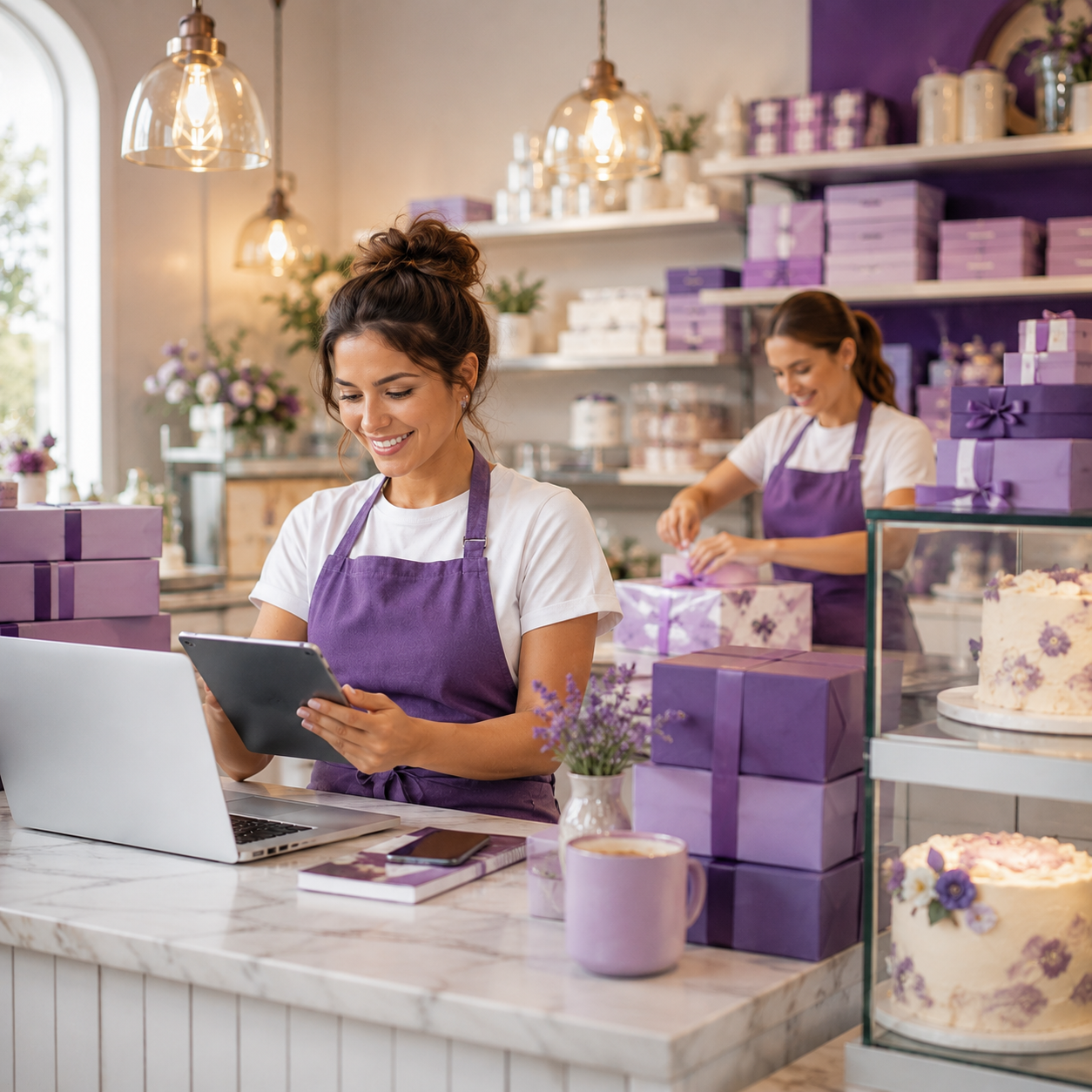
Want to start a bakery in the UK? Learn how to create a business plan, register your bakery, understand food hygiene, allergens, costs, pricing, payments and more.
Starting a bakery can begin in many different ways.
You might start baking celebration cakes from your home kitchen. You might be opening your first cake shop on the high street. Perhaps you're building a specialist cupcake business, dessert shop, wholesale bakery or online cake brand.
Whatever your starting point, turning baking skills into a successful business requires much more than making great cakes.
You need to think about food safety, business registration, pricing, premises, equipment, allergens, payments, customers, marketing, staffing and how you're going to manage orders as the business grows.
This guide takes you through the major steps involved in starting a bakery in the UK.
Quick answer: To start a bakery in the UK, you'll normally need to choose your business model, create a business plan, decide on a legal structure, register your food business with your local authority at least 28 days before trading, establish food-safety and allergen procedures, arrange suitable premises and insurance, price your products, set up payments and order management, and start marketing your bakery.
Food-business requirements vary depending on where in the UK you operate and exactly what your business does, so always check the current requirements with your local authority and relevant food standards authority.
1. Decide what type of bakery you want to start
Before thinking about logos, shop interiors or Instagram accounts, decide what kind of bakery you're actually building.
There are several possible models.
Home bakery
You prepare cakes or baked products from your home and sell through channels such as:
Instagram
Facebook
TikTok
Your website
WhatsApp
Telephone orders
Local recommendations
Starting from home can allow you to test demand before taking on the cost of commercial premises.
Cake shop
A physical cake shop allows customers to visit, browse products, discuss bespoke cakes and collect orders.
Your business could focus on:
Birthday cakes
Celebration cakes
Wedding cakes
Cupcakes
Children's cakes
Baby shower cakes
Anniversary cakes
Custom-designed cakes
Traditional bakery
A bakery might sell a wider range including:
Bread
Pastries
Cakes
Cookies
Doughnuts
Sandwiches
Savoury products
Coffee
Bakery café
A bakery café combines retail bakery products with eat-in food and drinks.
This introduces additional decisions around seating, staffing, food preparation, licences and VAT.
Online bakery
Some businesses operate predominantly online and deliver products locally or nationally.
Wholesale bakery
Instead of mainly selling directly to consumers, you could supply cafés, restaurants, hotels, supermarkets, corporate customers or other retailers.
Your business model determines almost everything that follows, from your premises to your equipment and pricing.
2. Choose your bakery niche
Trying to sell everything to everyone can make it difficult to stand out.
A clear specialism can make your bakery easier to market.
For example:
Celebration cakes
Birthday, anniversary and occasion cakes.
Luxury cakes
Higher-value cakes with premium decoration and presentation.
Cupcakes
Individual cakes, gift boxes and corporate orders.
Eggless cakes
A potentially valuable market in areas with strong demand for egg-free cakes.
Vegan bakery
Plant-based cakes and baked goods.
Gluten-free bakery
A specialist proposition requiring particularly careful ingredient and cross-contact management.
South Asian cakes
Flavours such as rasmalai, pistachio, mango, cardamom or gulab jamun-inspired cakes.
Wedding cakes
High-value bespoke products involving consultations and advance bookings.
Dessert bakery
Cheesecakes, brownies, cookies, waffles and other desserts.
You can still sell multiple products.
The objective is to give customers a clear reason to choose your bakery.
3. Research the local bakery market
Before opening, understand the market you're entering.
Search Google for terms such as:
cake shop near me
bakery near me
birthday cakes [your town]
custom cakes [your town]
eggless cakes [your town]
wedding cakes [your town]
Look at competing bakeries and ask:
What products do they sell?
How much do they charge?
What are customers saying in reviews?
How quickly do they respond to enquiries?
Do they offer online ordering?
Do they offer delivery?
What is their food hygiene rating?
How large is their social following?
What does their website look like?
What products appear most popular?
What are customers complaining about?
Google reviews can be particularly useful.
If multiple customers complain that local bakeries don't answer phones, miss collection times or make ordering difficult, those problems can become opportunities for your new bakery.
4. Write a simple bakery business plan
You don't necessarily need a 50-page document.
But you should understand how the business is going to make money.
Your bakery business plan should cover:
Business concept
What are you selling and who are you selling it to?
Target customer
For example:
Families buying birthday cakes.
Parents buying children's celebration cakes.
Couples buying wedding cakes.
Businesses buying corporate cakes.
Walk-in customers buying pastries.
Products
Create your initial product range.
Avoid launching with hundreds of options.
Start with products you know you can produce consistently and profitably.
Pricing
Work out:
Ingredient cost
Packaging
Labour
Delivery
Payment-processing fees
Rent
Utilities
Marketing
Software
Insurance
Waste
Taxes
Desired profit margin
We'll come back to pricing shortly.
Sales forecast
Estimate how many orders you'll realistically need each week and month.
For example:
If your average order is £60 and your target monthly sales are £12,000, you'll need approximately 200 orders per month.
That immediately gives you a better understanding of the scale of operation you need.
Marketing strategy
Think about how people will discover you.
Possible channels include:
Google
Google Maps
Instagram
Facebook
TikTok
Your website
Email marketing
Customer referrals
Loyalty programmes
Local partnerships
Paid advertising
Growth strategy
Consider what happens if the bakery succeeds.
Could you:
Hire additional decorators?
Move from home into commercial premises?
Open another location?
Introduce delivery?
Sell online?
Create a franchise?
Supply other businesses?
Thinking ahead helps you avoid building processes that only work while you're handling ten orders per week.
5. Decide how to structure your bakery business
Many small UK businesses start as either a sole trader or limited company.
Sole trader
A sole trader is generally the simplest structure to start and administer.
As of August 2026, GOV.UK states that you must register as a sole trader for Self Assessment if you earn more than £1,000 in a tax year from self-employment, among other circumstances.
Limited company
A limited company is legally separate from its owners.
You'll normally need to register the company with Companies House, appoint at least one director and fulfil ongoing company and tax responsibilities.
Which structure works best depends on factors including:
Your expected income
Ownership
Liability
Tax
Funding requirements
Growth plans
If you're unsure, speak to an accountant.
For a growing bakery, getting accounting advice early can prevent unnecessary problems later.
6. Register your bakery as a food business
This is one of the most important steps.
If you're starting a new food business or taking over an existing one, you generally need to register with your local authority at least 28 days before you start trading.
Registration is free.
This applies to many different types of operations, including businesses selling food:
From a shop
From home
Online
Through social media
For delivery
From temporary premises
If you're operating in Scotland, Food Standards Scotland also states that food businesses must register with their local authority at least 28 days before opening.
Don't leave registration until your opening day.
Build it into your launch schedule.
7. Can you start a bakery from home?
Yes, many successful cake businesses start from home.
But running the business from your house does not mean food-business rules disappear.
You may need to consider permissions from your:
Mortgage provider
Landlord
Local planning authority
Local council
You should also check your insurance because ordinary home insurance might not cover business equipment, stock or customers visiting your property.
You still need to register your food business where required.
Your home food-preparation area will also need to meet applicable food hygiene requirements.
For many cake entrepreneurs, starting from home can be a sensible way to prove the business before committing to a shop lease.
8. Find suitable bakery premises
If you're opening a physical bakery or cake shop, don't choose premises based only on how attractive the shopfront looks.
Consider the operational space behind it.
You'll potentially need room for:
Mixers
Ovens
Refrigerators
Freezers
Preparation tables
Decorating areas
Ingredient storage
Finished cake storage
Packaging
Washing facilities
Handwashing
Waste
Customer collections
The Food Standards Agency advises food businesses to consider facilities including adequate handwashing, ventilation, lighting, drainage and surfaces that can be effectively cleaned.
Before signing a long lease, also check whether your intended use is appropriate for the premises and whether you need any planning or other local authority permissions.
The cheapest shop is not necessarily the cheapest bakery if you subsequently have to spend heavily modifying it.
9. Understand business rates
If you operate from commercial premises, business rates may become another cost.
For businesses in England, current small business rate relief may apply where the property's rateable value is below £15,000 and other eligibility requirements are met.
If your property has a rateable value of £12,000 or less and is your only qualifying property, you may currently receive 100% small business rate relief. Relief gradually reduces between £12,001 and £15,000.
The business-rates system differs across the UK, so check the rules applicable to your location.
Always investigate rates before agreeing to commercial premises.
10. Set up your bakery food-safety system
Opening a food business means taking responsibility for the safety of the food you sell.
Your processes should cover areas such as:
Cleaning
Food preparation
Storage
Chilling
Cross-contamination
Personal hygiene
Pest control
Ingredient traceability
Allergen management
Staff training
Food Standards Agency guidance also makes Safer Food Better Business resources available to businesses in England and Wales to support food-safety management.
Don't create these procedures simply because you expect an inspection.
They should become part of how your bakery operates every day.
11. Prepare for your food hygiene inspection
After registering your bakery, your local food safety team will be notified.
You do not generally have to separately request your first inspection. Depending on risk and local authority priorities, the inspection may happen some time after registration. Inspections are usually unannounced.
In England, Wales and Northern Ireland, businesses covered by the Food Hygiene Rating Scheme can receive a rating from:
5 – Very good
through to
0 – Urgent improvement required
Inspectors consider areas including:
How hygienically food is handled
The condition of the premises
How effectively food safety is managed
The Food Standards Agency says all businesses should be capable of achieving the highest rating of 5.
Scotland uses the separate Food Hygiene Information Scheme, including outcomes such as Pass and Improvement Required.
Related Rise guide:How to Get a 5-Star Food Hygiene Rating for Your Bakery or Cake Shop.
12. Understand allergen requirements
For a cake business, allergens need particular attention.
Typical cake ingredients can contain allergens including:
Cereals containing gluten
Eggs
Milk
Nuts
Peanuts
Soya
Sesame
You need accurate information about the allergens present in your products and appropriate procedures for managing cross-contact.
This becomes especially important when customers request products described as:
eggless
dairy-free
gluten-free
nut-free
vegan
Bespoke cakes can make allergen management more complicated because different fillings, decorations, chocolates and toppings may change the allergen profile of the finished product.
If you sell products that qualify as prepacked for direct sale (PPDS), Natasha's Law requires the product to carry its name and full ingredients list, with regulated allergens appropriately emphasised. Cakes and pastries packaged at the bakery before being selected by a customer can potentially fall within PPDS rules.
Related Rise guide:How to Manage Allergens in a Cake Shop.
13. Train your bakery staff
Food handlers need appropriate skills and up-to-date training for the work they carry out.
Interestingly, UK guidance does not say every food handler legally needs to possess a food hygiene certificate.
Businesses must instead be able to demonstrate appropriate skills and training, which can come through courses, on-the-job training, self-study or previous relevant experience.
Staff must also be appropriately trained to manage allergies.
Keep records of training.
Remember that training shouldn't only apply to bakers.
Someone answering the phone or taking an Instagram order could receive an important allergy request.
Someone packing an order could give a customer the wrong product.
The whole customer journey matters.
14. Work out how much your cakes actually cost
One of the biggest mistakes new bakery owners make is setting prices based on what competitors charge.
Instead, understand what your product actually costs you.
For every cake, consider:
Ingredients
Flour
Eggs
Butter
Cream
Sugar
Chocolate
Fillings
Fruit
Flavourings
Colours
Decorations
Packaging
Cake boards
Cake boxes
Cupcake boxes
Labels
Bags
Ribbons
Labour
How long does the cake actually take?
Don't value three hours of decorating at £0 simply because you're doing the work yourself.
Business overheads
Include costs such as:
Rent
Electricity
Gas
Water
Insurance
Business rates
Software
Card processing
Marketing
Accountancy
Waste collection
Equipment maintenance
Profit
Your price needs to leave room for profit after business costs.
Being busy doesn't automatically mean being profitable.
A bakery taking 100 badly priced orders can make less money than one completing 50 profitable orders.
15. Understand VAT before your bakery grows
VAT for bakeries has some unusual rules.
The general compulsory VAT registration threshold is currently £90,000 of taxable turnover, based on the applicable tests. Businesses below the threshold may also register voluntarily.
But the VAT treatment of bakery products varies.
HMRC guidance states that many traditional bakery products such as cakes, bread and certain biscuits are zero-rated, while products such as confectionery and chocolate-covered biscuits can be standard-rated.
Wedding, anniversary and birthday cakes are specifically included among examples of zero-rated cakes in HMRC guidance.
There are also additional rules concerning catering, eat-in sales and hot takeaway food.
This makes it particularly important for bakeries selling a mixture of cakes, drinks, confectionery, hot food and eat-in products to obtain appropriate tax advice.
Don't assume every item sold inside a bakery has the same VAT treatment.
16. Arrange the right insurance
The exact cover you need will depend on the business.
Potential insurance requirements and options can include:
Employers' liability insurance
Public liability insurance
Product liability insurance
Contents and equipment cover
Business interruption cover
If you become an employer, Employers' Liability insurance is generally compulsory unless a specific exemption applies.
The policy must provide cover of at least £5 million.
Talk to an insurance broker about the appropriate cover for your particular bakery operation.
17. Think about licences before you open
A standard cake shop may not require every type of premises licence, but your activities can change the requirements.
For example, in England and Wales a premises licence can be required for activities including:
Selling alcohol
Certain entertainment
Serving hot food or hot drinks between 11pm and 5am
Other requirements may depend on your local authority, location and business model.
Check licences before building services into your business rather than discovering the issue after launch.
18. Arrange commercial waste collection
Once you're running a bakery, your waste is business waste.
That could include:
Food waste
Cardboard
Packaging
Plastic
Ingredient containers
General waste
Businesses have responsibilities for storing and disposing of commercial waste appropriately and ensuring waste carriers are authorised.
Current guidance in England also includes requirements around workplace recycling.
Do not simply assume normal household waste arrangements can be used for a commercial bakery.
19. Decide how customers will order cakes
This is where many cake shops become unnecessarily complicated.
A customer finds you on Instagram.
They send a direct message.
You ask them to WhatsApp you.
They send a photo.
You write the order into a diary.
They transfer a deposit.
Someone writes a collection date on a paper order form.
A decorator later needs to find the original Instagram conversation.
This might work with five orders.
It becomes much harder with 100.
Before opening, decide how your cake-order process should work.
For a bespoke cake order, you might need to capture:
Customer name
Mobile number
Email address
Cake type
Cake size
Sponge flavour
Filling
Design
Colour
Message on cake
Allergens
Image reference
Collection date
Collection time
Delivery address
Total price
Deposit
Outstanding balance
Payment status
Special instructions
This information should ideally follow the order from the customer to the baker and through to collection or delivery.
20. Decide how you'll take payments
Your customers may want to pay through:
Debit card
Credit card
Payment link
Contactless payment
Online checkout
QR code
Bank transfer
Digital wallets
Cash
For bespoke cakes, you also need to decide:
How much deposit is required?
When is the outstanding balance due?
Is the deposit refundable?
How are cancellations handled?
What happens if the customer changes the design?
Can customers pay remotely?
Write clear terms before you start taking substantial orders.
21. Build a customer database from day one
Your first customer shouldn't disappear after collecting their cake.
A birthday cake customer could come back:
Next birthday.
Their child's birthday.
Their partner's birthday.
An anniversary.
A baby shower.
A wedding.
Another family celebration.
Cake businesses have an unusual advantage: many of the events they serve happen repeatedly.
Yet many cake shops record only a customer's name and mobile number on a paper order form.
Consider collecting appropriate customer information such as:
Name
Email
Mobile
Previous orders
Important dates
Preferences
Marketing consent where required
Handled properly, your existing customers can become one of your bakery's most valuable growth channels.
22. Create a collection and delivery process
Customers shouldn't have to wonder whether their cake will be ready.
Decide how the process works from the beginning.
For example:
Order confirmed
↓
Deposit received
↓
Reminder before production
↓
Cake prepared
↓
Customer notified that order is ready
↓
Collection or delivery
↓
Final payment confirmed
↓
Order completed
↓
Review request
This makes the experience more professional while reducing repetitive phone calls asking:
“Is my cake ready?”
23. Create your bakery brand
Your brand is more than your logo.
Think about:
Bakery name
Logo
Colour palette
Packaging
Photography
Cake presentation
Shop design
Tone of voice
Customer service
Website
Social media
Ask yourself:
Would someone recognise one of our cakes without seeing our name?
Strong bakery brands develop a visual style that customers begin to recognise.
24. Build a website
Social media is valuable, but your entire business shouldn't depend on an Instagram account.
A good bakery website can include:
Your cake range
Pricing guidance
Gallery
Locations
Opening hours
Contact information
Order enquiry
Collection information
Delivery information
Allergen information
FAQs
Customer reviews
Optimise the website for local searches such as:
cake shop in Croydon
birthday cakes in Birmingham
eggless cake shop Manchester
custom cakes near me
Google search and Google Maps can become particularly valuable channels for local bakeries.
25. Set up your Google Business Profile
For a physical bakery, your Google Business Profile can be one of your most important marketing assets.
Customers increasingly search:
cake shop near me
or
bakery near me
rather than searching for a particular bakery name.
Complete your profile with:
Accurate business name
Address
Phone number
Opening hours
Website
Services
Products
Photos
Updates
And actively ask satisfied customers for reviews.
Your food hygiene rating, Google reviews, cake photography and customer experience all contribute to trust.
26. Use Instagram and TikTok to show your products
Few products are as naturally suited to visual marketing as cakes.
Create content showing:
Cake transformations
Decorating
Behind-the-scenes baking
Before and after
Customer collections
New designs
Trending cakes
Seasonal products
Staff
Customer reactions
Cake-making tips
Don't make every post an advertisement.
Show the craftsmanship behind the product.
27. Encourage repeat business
Acquiring a new customer can take considerably more effort than getting an existing happy customer to return.
Create reasons to come back.
For example:
Loyalty rewards
Reward customers after a certain number of purchases.
Birthday reminders
Remind customers when an important date approaches.
Referral rewards
Encourage customers to introduce friends and family.
Email campaigns
Promote Valentine's Day, Mother's Day, Eid, Easter, Father's Day, Halloween, Christmas and other relevant occasions.
Review requests
Ask happy customers to leave feedback after collecting their cake.
A cake shop shouldn't think only about today's transaction.
Think about the lifetime relationship with that customer.
28. Choose systems that can grow with your bakery
When you're just starting, paper might feel simpler.
But think about what happens when the business grows.
You could eventually have:
Hundreds of customers
Several employees
Multiple decorators
Online orders
Walk-in orders
Delivery orders
Deposits
Outstanding balances
Thousands of previous orders
Loyalty rewards
Reviews
Marketing campaigns
Multiple locations
You don't want to rebuild your entire operating system every time the bakery becomes more successful.
That's why choosing the right technology early can make a significant difference.
How Tolloz can help a growing bakery
Most generic business systems weren't created around the way bespoke cake shops actually work.
A cake order is often more complicated than scanning a product and taking payment.
There can be:
A customer.
An occasion.
A cake specification.
A reference image.
A collection date.
A deposit.
An outstanding balance.
Special instructions.
Customer communication.
And eventually another opportunity to bring that customer back.
Tolloz is being built specifically for bakeries and cake shops to bring more of this process together in one cloud-based platform.
The aim is to help bakery owners manage areas such as:
Cake orders
Customer information
Payments
Deposits
Collection details
Order communication
Customer relationships
Loyalty
Reviews
Business reporting
Rather than stitching together an EPOS system, paper order book, spreadsheet, WhatsApp, payment terminal, email platform and customer database, the goal of Tolloz is to give bakeries a more connected way to operate.
Because your bakery should become easier to manage as it grows — not harder.
Starting a bakery in the UK checklist
Before launching, work through this checklist.
Business
Decide your bakery model
Identify your target customer
Research competitors
Choose your products
Write your business plan
Choose your business structure
Open appropriate banking arrangements
Set up bookkeeping and accounting
Understand VAT implications
Food safety
Register your food business
Create food-safety procedures
Establish cleaning procedures
Create an allergen-management system
Train staff
Prepare for inspection
Set up ingredient traceability
Arrange pest-control procedures
Create temperature-control procedures where required
Premises
Confirm appropriate permissions
Review planning requirements
Check utilities
Install suitable equipment
Check ventilation
Arrange handwashing
Set up safe food storage
Arrange commercial waste
Check business rates
Arrange insurance
Check fire-safety responsibilities
Operations
Create your cake-order process
Define deposit rules
Set up payments
Establish pricing
Set collection procedures
Set delivery procedures
Create customer records
Establish cancellation terms
Create staff responsibilities
Marketing
Choose your bakery name
Create your brand
Buy your domain
Build your website
Create your Google Business Profile
Set up Instagram
Set up Facebook
Consider TikTok
Photograph your cakes professionally
Create a review strategy
Create a customer loyalty strategy
Start small. Build the right foundations. Then grow.
Starting a bakery can be incredibly rewarding.
You get to create products that become part of people's birthdays, weddings, anniversaries and some of their most memorable moments. But a successful bakery needs more than great baking.
You need good food-safety practices.
Good pricing.
Good customer service.
Good marketing.
And good systems.
The businesses that grow successfully are often those that establish these foundations before their order volume becomes difficult to manage.
Rise by Tolloz is here to help bakery and cake shop owners understand the business side of baking from launching your first cake business to managing customers, payments, marketing and growth.
And when you're ready to make the day-to-day operation of your bakery simpler, Tolloz is being built as the all-in-one business platform specifically for bakeries and cake shops.
Start your Tolloz free trial and build your bakery on better systems from day one.
Frequently asked questions about starting a bakery in the UK
Do I need a licence to start a bakery in the UK?
There isn't one universal “bakery licence” covering every bakery business. However, you normally need to register the food business with your local authority, and additional licences or permissions may apply depending on your premises and activities.
Do I need to register my bakery with the council?
Food businesses generally need to register with their local authority at least 28 days before trading. Registration is free.
Can I start a bakery from home in the UK?
Yes. However, you still need to comply with applicable food-business requirements and may need permission from your landlord, mortgage provider, local planning authority or council depending on your circumstances.
Do I need a food hygiene certificate to sell cakes?
Food handlers do not automatically need to hold a formal food hygiene certificate. However, businesses must be able to demonstrate that staff have appropriate skills and training for their roles, including allergen training.
How long before opening should I register my bakery?
You should normally register your food business with the local authority at least 28 days before you start trading.
How much does it cost to start a bakery in the UK?
There is no single figure.
A home cake business could require relatively modest startup investment if you already own suitable equipment.
Opening a high-street bakery can require significantly more because you may need to fund:
Lease deposit
Rent
Shop fitting
Ovens
Refrigeration
Mixers
Furniture
Signage
Packaging
Insurance
Utilities
Initial ingredients
Technology
Marketing
Staff
Working capital
Rather than choosing an arbitrary startup budget, create a detailed cost forecast for your specific model and maintain enough working capital to cover the period before sales become predictable.
Can I sell cakes on Instagram from home?
Selling food through social media is still operating a food business. Registration and food-safety obligations can apply in the same way as other food businesses. Food Standards Scotland explicitly states that selling food online or through social media remains food-business activity, and the FSA provides equivalent guidance for distance selling.
Do I need VAT registration for my bakery?
You must generally register for VAT when your taxable turnover exceeds the applicable compulsory registration threshold. As of August 2026, the threshold is £90,000.
Bakery VAT can be complex because different products and types of supply can receive different VAT treatment.
Are cakes subject to VAT?
Many traditional cakes are zero-rated for VAT. HMRC guidance specifically lists sponge cakes, fruit cakes and celebration cakes such as wedding, anniversary and birthday cakes among zero-rated products. Other bakery or confectionery products may be standard-rated, so businesses with a varied product range should obtain appropriate advice.
What food hygiene rating should a new bakery aim for?
In England, Wales and Northern Ireland, businesses covered by the Food Hygiene Rating Scheme should aim for 5 – Very Good. The Food Standards Agency says all businesses should be capable of achieving a 5. Scotland operates a different hygiene information scheme.
What equipment do I need to start a bakery?
Your requirements depend on what you sell, but a cake-focused bakery might need:
Commercial or suitable ovens
Mixers
Refrigeration
Freezers
Worktables
Cake tins
Scales
Storage
Decorating equipment
Washing facilities
Shelving
Cake-display equipment
Packaging
Payment equipment
Buy equipment according to the products and volume you expect to produce rather than filling the kitchen with equipment you may rarely use.
Is a bakery profitable?
A bakery can be profitable, but revenue alone doesn't determine profitability.
Margins depend on factors including:
Ingredient costs
Labour
Pricing
Rent
Utilities
Waste
Delivery
Marketing
Product mix
Order volume
Bespoke cakes can command higher prices but may also require substantial labour.
Understanding the true cost of producing every product is essential.
Start your Tolloz free trial and build your bakery on better systems from day one.
This guide provides general business information and should not be treated as legal, tax, accounting or food-safety advice. Requirements differ depending on your location and business activities, and regulations can change. Always check current guidance from GOV.UK, the Food Standards Agency, Food Standards Scotland, HMRC and your local authority and seek professional advice where appropriate.