
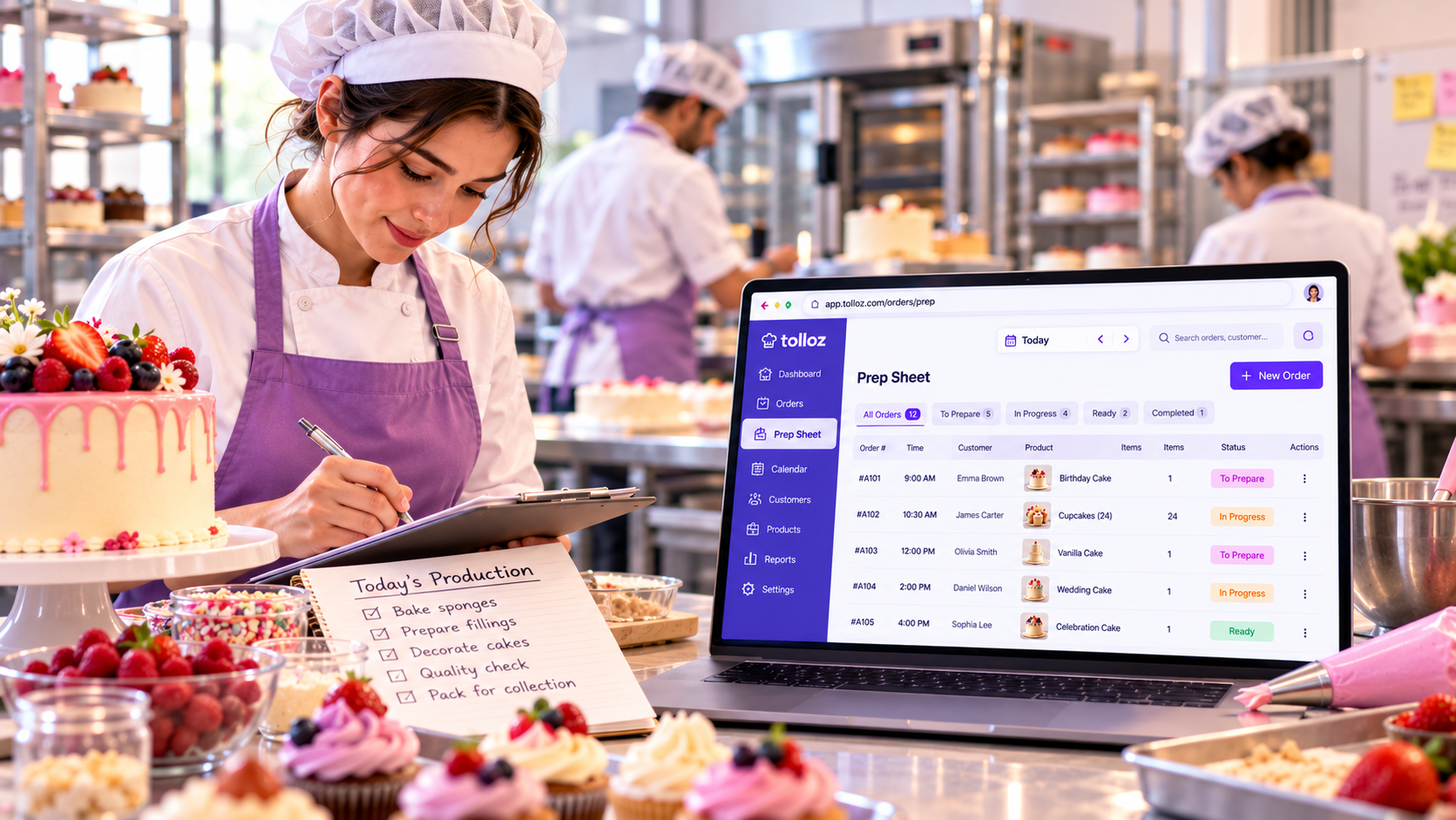
Discover how a bakery production sheet helps organise daily orders, clarify kitchen tasks and reduce mistakes. Explore Tolloz's digital solution.
Imagine it is 8 am on a Saturday. Your bakery is preparing for a busy day, the kitchen team is ready to start, and customers are expecting birthday cakes, celebration cakes and other freshly made products. But there is a problem.
One employee is checking handwritten order slips. Another is scrolling through customer messages to find a cake design. The production manager is trying to work out which orders need to be prepared first, while someone at the counter is asking whether a particular cake will be ready for collection by noon.
Everyone is working hard, yet the day already feels disorganised. For many bakeries, the challenge is not a lack of skill or effort. It is the difficulty of turning customer orders into a clear, realistic production plan.
When order details, collection dates, cake specifications and preparation instructions are scattered across different places, even an experienced team can struggle to keep everything moving smoothly.
This is where bakery production planning software can make a meaningful difference. It helps bakery owners and production teams organise upcoming orders, understand what needs to be prepared and coordinate daily work more effectively.
In this guide, we will explain how bakery production planning works, how to organise your kitchen workload, which common mistakes to avoid and how a connected bakery management platform such as Tolloz can help you bring your daily operations together.
Why Bakery Teams Need a Better Way to Organise Orders
Taking an order is only the beginning of the bakery workflow. Once a customer confirms a cake, the team must translate the booking into practical preparation instructions. Someone needs to understand what to bake, which ingredients or fillings are required, how the product should be decorated and when it must be ready. For standard products, this process may be straightforward. Custom cake orders can be more demanding because every booking may have different specifications.
Consider a cake shop handling birthday cakes, wedding cakes, cupcakes and celebration cakes on the same day. A birthday cake might require a specific colour combination and personalised message. A wedding cake may need multiple tiers and coordinated decoration. Cupcake orders may involve several flavours and different quantities.
These orders cannot always be managed using a single handwritten note or a verbal handover. The challenge becomes greater when several employees are involved. The person who takes the booking may not be the person who prepares the cake, and the employee responsible for collection may need to confirm whether the order is ready.
Without a consistent production document, each handover creates another opportunity for information to be missed. A bakery production sheet gives the team a shared reference point. Instead of repeatedly asking what needs to be done, employees can check the relevant instructions and focus on preparing the products correctly.
What Is a Bakery Production Sheet?
A bakery production sheet is a document or digital record that communicates the information a production team needs to prepare bakery orders. It typically brings together essential order details, product specifications, preparation requirements and deadlines.
Depending on the bakery's workflow, a production sheet may include the customer's order number, product name, quantity, flavours, filling, design notes, reference images, collection date and special instructions.
The purpose is simple: help kitchen staff understand what they need to prepare without searching through multiple sources. A production sheet is different from a customer order form. An order form captures the customer's requirements when the booking is made. A production sheet organises the relevant information so the kitchen can act on it.
It is also different from a production calendar. A calendar helps the team see when orders are due, while a production sheet provides the practical details needed to prepare those orders. Used together, these tools can make the journey from booking to collection much easier to manage.
What Information Should a Bakery Production Sheet Include?
The information required depends on the products you sell and how your kitchen operates. A custom cake studio will need more design detail than a bakery producing standard loaves or pastries. However, most production sheets should cover a few essential areas.
| Information | Why it matters |
|---|---|
| Order number or reference | Helps staff identify the correct booking |
| Product and quantity | Clarifies what needs to be prepared |
| Cake size, shape and flavour | Reduces confusion about product specifications |
| Filling and other options | Helps the kitchen follow the confirmed requirements |
| Design instructions and reference images | Supports accurate decoration and personalisation |
| Collection or delivery deadline | Establishes when the order must be ready |
| Special instructions | Highlights allergies, personalisation or other relevant requirements where properly recorded |
| Order status | Helps the team understand whether work is pending, underway or complete |
For example, an instruction such as “birthday cake, Friday” leaves too much room for interpretation. A useful production record might specify a 20 cm chocolate cake with vanilla filling, a blue and white design, the customer's approved reference image and the agreed collection time.
The team should not have to guess what the customer meant. It is equally important to keep information accurate. If the customer changes the design after the order has been confirmed, the updated instruction should be reflected in the production record and communicated to the relevant staff.
How Kitchen Production Sheets Improve Bakery Workflow
1. Give every team member clearer instructions
A kitchen works more smoothly when employees know what they are responsible for. Without a production sheet, one baker may receive instructions verbally, another may rely on a handwritten note, and a decorator may use a customer image saved on a different device.
These different sources can create uncertainty about which instruction is correct. A shared production sheet gives staff a consistent place to check the requirements for an order. For example, if a customer requests a specific filling and decoration, the relevant details can be recorded with the order rather than relying on the original employee to remember them.
This is especially helpful when a shift changes or a colleague takes over an order halfway through preparation. The benefit is not just fewer questions. It is a team that can work with more confidence because the information it needs is easier to find.
2. Reduce errors caused by missing information
A small misunderstanding can have a significant impact in a custom cake business. Imagine preparing a cake with the wrong filling because the latest customer change was recorded in a message that the kitchen never saw. The team may need to remake part of the product, spend additional time correcting the issue or explain the problem to a disappointed customer.
A production sheet helps reduce this risk by keeping the confirmed requirements visible. It should be treated as a working record, not a document that is created once and then ignored. When important order details change, the record must be updated through a consistent process. No document can eliminate every mistake, but clear instructions make it easier to prevent avoidable ones.
3. Help kitchen managers prioritise the day's work
A production sheet becomes more valuable when it is used alongside a clear schedule. Consider a bakery with ten orders due on Saturday. Some are simple cupcake orders, while others are custom cakes that require detailed decoration. If the team only looks at the collection times, it may start with the earliest order and leave complex work until too late.
A more effective approach considers the time and stages required to prepare each product. The manager can identify which tasks need to happen first, which components can be prepared in advance and which orders require additional attention. The production sheet provides the product details, while the schedule helps organise the timing. Together, they help the team understand not only what must be prepared, but also when the work needs to happen.
4. Improve communication between front-of-house and kitchen teams
The counter team and the kitchen have different responsibilities, but they depend on the same order information. Front-of-house staff need to capture the customer's requirements accurately. Kitchen staff need to turn those requirements into a finished product. The manager needs visibility across both activities.
If each team uses separate records, important details can get lost during handovers. A consistent production sheet helps connect the original booking with the instructions used in preparation. For example, when a customer calls to confirm a personalised message, the employee taking the call should update the order information and make sure the kitchen receives the change. This creates a more reliable process than relying on verbal updates alone.
5. Make custom cake production easier to manage
Custom cakes often involve more detailed requirements than standard bakery products. A single order might include the cake size, sponge type, filling, number of tiers, colour palette, decorative elements, written message and a reference image.
If those details are spread across several messages, staff may need to search through them each time they work on the cake. A production sheet can bring the relevant information together, helping the baker and decorator work from the same specifications.
Reference images are particularly useful because descriptions such as “soft pink floral design” can mean different things to different people. Keeping the customer's approved design reference with the order gives the team a clearer visual guide. The result is a more organised preparation process and a better chance of delivering the product the customer expects.
6. Support smoother collections and deliveries
The production workflow does not end when baking and decorating are complete. Finished products may still need final quality checks, packaging, labelling and preparation for collection or delivery. If the team cannot easily identify which orders are ready, staff may spend unnecessary time checking with the kitchen or searching through records.
A production sheet that works alongside order-status tracking helps the team understand where each booking stands. For example, the bakery can distinguish between an order that is still being decorated and one that has passed its final check and is ready for collection.
This improves internal coordination and helps front-of-house employees answer customer questions more confidently.
Bakery Production Sheet Example
Imagine a cake shop preparing several orders for the following day.
A simple production sheet could look like this:
| Order | Product | Key requirements | Collection | Priority |
|---|---|---|---|---|
| A101 | Birthday cake | Chocolate sponge, vanilla filling, blue decoration | 10:00 am | Prepare early |
| A102 | Cupcakes | 24 cupcakes, mixed flavours, boxed | 11:30 am | Morning batch |
| A103 | Anniversary cake | Vanilla sponge, floral design, personalised message | 1:00 pm | Decoration time needed |
| A104 | Wedding cake | Three tiers, approved design reference, final assembly | 3:00 pm | Plan preparation in advance |
This example is illustrative. The exact production stages and timings will depend on the bakery's recipes, equipment, staff and product complexity. Notice that the table does more than list the products. It highlights the requirements that affect preparation and helps the manager identify which tasks need attention.
For the wedding cake, for instance, the team may need to complete certain preparation stages before the collection day. For the cupcake order, batching production may be practical if the recipe and workflow allow it. The production sheet provides the necessary details. The manager uses those details to build a realistic schedule around available capacity.
Paper Production Sheets vs Digital Production Sheets
Paper production sheets can work well for bakeries with a small number of orders and a straightforward workflow. They are familiar, inexpensive and easy to place near a workstation. However, paper records have limitations when order volumes increase or several employees need access to the same information.
A sheet may be misplaced, become difficult to read or fail to reflect a last-minute customer change. If order details are originally recorded in a digital system, someone may also need to copy the information manually onto paper. Digital production sheets can reduce some of these challenges by keeping production information connected to the order record.
| Area | Paper production sheet | Digital production sheet |
|---|---|---|
| Access | Usually available where the sheet is stored | Can be available on supported connected devices |
| Updating changes | May require reprinting or handwritten corrections | Can be updated in the relevant digital record |
| Finding order details | May require sorting through physical sheets | Can be easier when records are searchable |
| Connection to customer orders | Often requires manual transfer of information | Can be connected to the original order in an integrated system |
| Best fit | Simple workflows with few orders | Teams seeking more centralised order and production information |
Digital does not automatically mean better. A complicated system that staff do not use consistently can create new problems. The right solution should match the bakery's actual workflow and make the information easier to access, not add unnecessary administrative work.
Common Mistakes to Avoid When Using a Bakery Production Sheet
Leaving out important specifications
A production sheet that only includes the product name and collection date may not give the kitchen enough information. For custom orders, include the confirmed details that affect preparation and decoration. Avoid making employees search through unrelated records for essential instructions.
Keeping outdated instructions
If a customer changes an order, the team needs to know which specifications are current. Establish a clear process for updating the order record and informing the employees responsible for preparation.
Treating the production sheet as the entire schedule
A production sheet tells the team what an order requires, but it may not explain how all the day's tasks should be sequenced. Use it alongside a production calendar or daily schedule so the manager can plan workloads and deadlines.
Recording information inconsistently
If one employee writes “chocolate sponge” while another uses a vague abbreviation, misunderstandings become more likely. Use consistent labels and standard fields wherever possible. This makes the production sheet easier to scan, especially when the kitchen is busy.
Forgetting final checks
A cake may be decorated but still need packaging, a name or message check, and confirmation that it is ready for collection. Include appropriate completion steps in the workflow so that production status reflects the actual state of the order.
How to Know Whether Your Production Sheets Are Working
You do not need to invent impressive statistics to evaluate whether your bakery's production process is improving. Start by observing the problems your team experiences today. Track a few practical measures over time:
| Measure | What to review |
|---|---|
| Preparation errors | How often orders need correction because instructions were missed |
| Late-ready orders | How frequently products are not ready by the agreed time |
| Time spent finding details | How often employees search through messages or paperwork |
| Repeated questions | Whether staff regularly need clarification about order specifications |
| Last-minute changes missed | Whether updates reach the people responsible for production |
| Collection issues | Whether finished orders are correctly identified and ready for handover |
Record a baseline before changing the process. Review the results after a few weeks and look for recurring patterns. For example, if the team frequently asks where to find customer reference images, attaching those images directly to order records may address the problem.
If late collections are common, the issue may involve scheduling rather than the production sheet itself. This distinction matters. A production sheet can improve the availability of information, but staff allocation, equipment capacity, ingredient supply and realistic preparation times also affect performance.
How Tolloz's Kitchen Production Sheet Helps Bakery Teams

Less Kitchen Chaos.
More Orders in Sync.
Bring order details, preparation tasks and collection times together, so your team can work with more clarity from prep to pickup.
Discover Tolloz's Kitchen Production Sheet →Tolloz is a cloud-based bakery EPOS, CRM and order management platform designed for cake shops, bakeries and custom cake businesses. Its Kitchen Production Sheet is designed to give production teams the information they need to prepare upcoming orders without relying entirely on handwritten order slips. Tolloz also provides order management and a production calendar, helping connect order details with upcoming work.
Keep production instructions connected to customer orders
Tolloz allows bakeries to maintain order information such as cake size, shape, sponge type, filling, flavour, design, reference images, special instructions and collection details. When the relevant information is recorded against the order, the kitchen has a clearer starting point for preparation. This is particularly valuable for custom cakes, where the difference between two orders may depend on several small but important details.
Give your team a clearer view of upcoming work
The Tolloz production calendar helps bakeries review upcoming orders and collection dates. Used alongside production instructions, this can help managers identify busy days and decide which tasks require attention first. Instead of focusing only on the next order to arrive, the team can plan around the work that must be completed over the coming days.
Connect the front counter and kitchen workflow
Tolloz brings order management, customer information and production-related tools together within one platform. This helps reduce dependence on separate notebooks, spreadsheets and messages for essential order information. It also supports a more consistent process when several employees handle bookings, preparation and collections. Tolloz is built specifically around bakery workflows rather than generic retail transactions. You can learn more about the product on the About Tolloz page.
Explore the available tools and pricing
Tolloz lists the Kitchen Production Sheet and Production Calendar as part of its bakery management offering. The Tolloz pricing page provides an overview of the current plan and included tools. If you are considering moving from paper order slips to a digital workflow, review the available features and confirm that they match the way your team prepares and hands over orders.
Frequently Asked Questions
What is a bakery production sheet?
A bakery production sheet is a document or digital record that gives kitchen staff the information needed to prepare bakery orders. It commonly includes product details, quantities, flavours, design instructions, deadlines and other requirements relevant to production.
Why is a production sheet important in a bakery?
It helps the team work from clear, consistent instructions. This can reduce confusion, make handovers easier and help staff understand what needs to be prepared for upcoming collections.
What should a cake production sheet include?
A cake production sheet should include the order reference, product type, size, flavour, filling, design requirements, reference images, special instructions and collection deadline. The exact fields depend on the products and processes used by the bakery.
What is the difference between a production sheet and a production calendar?
A production sheet provides the details needed to prepare an order. A production calendar gives the team an overview of upcoming orders and their dates. They serve different purposes and work well together.
Are digital bakery production sheets better than paper sheets?
Digital sheets can make it easier to find and update order information, particularly when several employees handle the same bookings. Paper sheets may still work for small, straightforward operations. The best choice depends on order volume, team size and how frequently information changes.
Can a bakery production sheet help reduce mistakes?
It can reduce errors caused by unclear or missing instructions, especially when the information is accurate and updated consistently. It cannot eliminate every mistake, so quality checks, staff training and clear communication remain important.
Does Tolloz provide a Kitchen Production Sheet?
Yes. Tolloz lists a Kitchen Production Sheet designed to help production teams access the information needed for upcoming orders without relying entirely on handwritten order slips. You can review the feature on the Tolloz pricing page.
Can Tolloz help manage upcoming cake orders?
Yes. Tolloz provides order management and a production calendar to help bakeries organise orders and view upcoming collection dates. Visit the Tolloz FAQ page for further information about order management and production planning.
Is a digital production sheet suitable for a small cake shop?
Yes. A small cake shop may benefit from digital production sheets if several employees handle orders or if custom cake specifications are difficult to manage on paper. Choose a solution that fits your current workflow and can support the way your business grows.
Give Your Kitchen a Clearer Way to Work with Tolloz
Your team should not have to spend valuable preparation time searching for messages, deciphering handwritten notes or asking colleagues to repeat information. Every order should give the kitchen a clear understanding of what needs to be made, which specifications matter and when the finished product must be ready.
A well-organised bakery production sheet helps make that possible. When it is connected to customer orders and a production calendar, it can also support smoother communication between the counter, kitchen and management team.
Tolloz brings these bakery workflows together through its order management tools, Kitchen Production Sheet and Production Calendar. If you are ready to move beyond scattered paperwork and give your team a more consistent way to prepare daily orders, explore what Tolloz can offer.
Discover Tolloz's Kitchen Production Sheet
Make production information easier to find, help your team stay organised and create more time to focus on the quality of every cake and baked product you deliver.
Rise by Tolloz provides practical advice to help bakeries and cake shops build better organised, more profitable businesses.
This article provides general business information and does not constitute legal, food-safety or data-protection advice. Requirements depend on your individual business circumstances and may change. Check current Food Standards Agency, Information Commissioner's Office and GOV.UK guidance and seek professional advice where appropriate.