
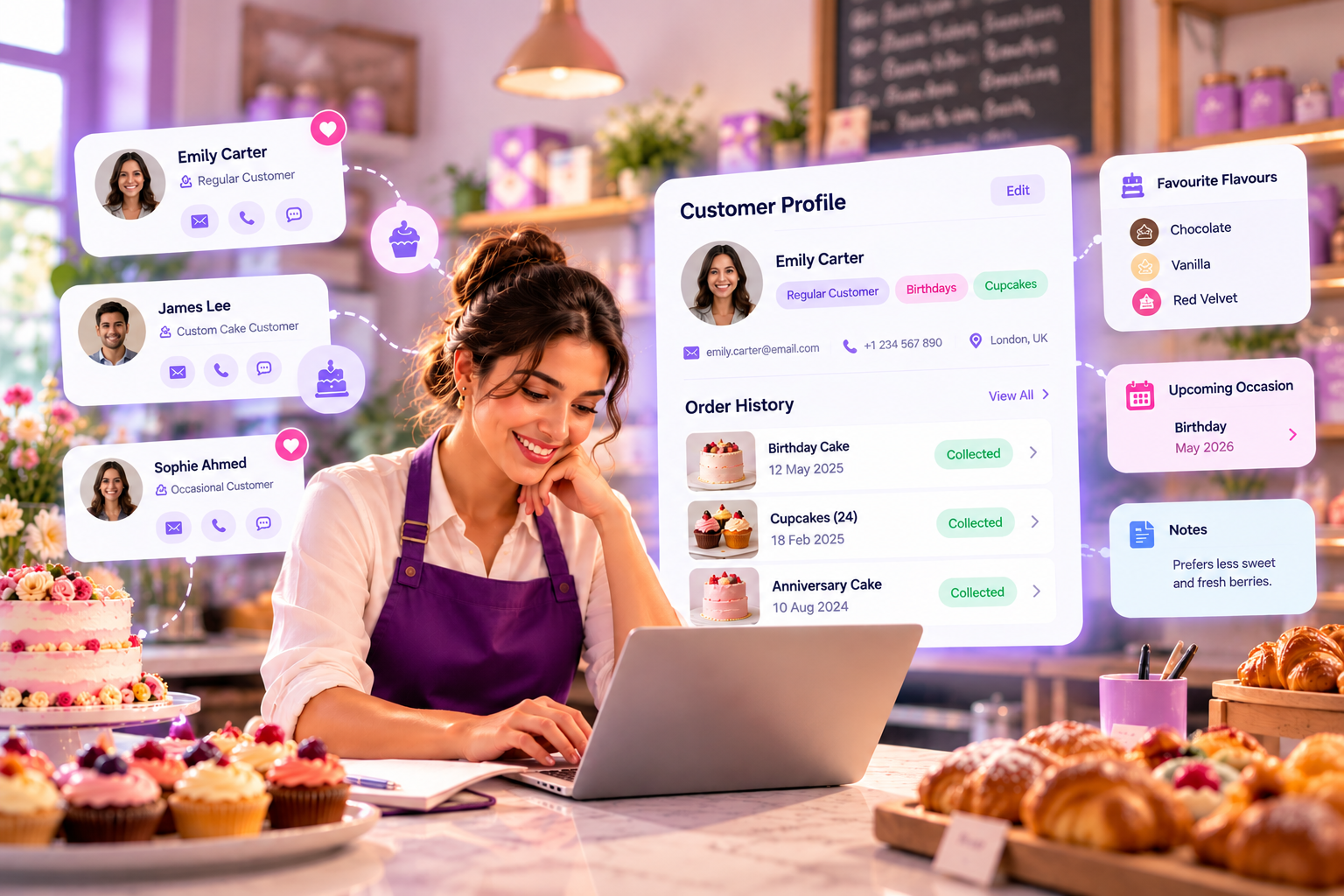
Discover how bakery CRM software helps you understand customer preferences, track order history, improve service and encourage repeat business with Tolloz.
Think about the customers who visit your bakery every week. Some buy bread and pastries for their families. Others order birthday cakes, wedding cakes or personalised treats for special occasions. Some customers visit once and never return, while others quietly become your most valuable regulars. Now consider a simple question: how much do you actually know about these customers?
You may recognise their faces, remember a few favourite products and know which customers regularly order celebration cakes. But as your bakery grows, remembering everyone's preferences becomes increasingly difficult. A customer who ordered a chocolate birthday cake last year might return this year expecting the same flavour, size and personal touch. If you cannot find their previous order, you may need to ask all the questions again. That is where bakery CRM software can make a real difference.
CRM stands for Customer Relationship Management. It helps businesses organise customer information, understand previous interactions and deliver a more consistent experience. For bakeries, this can mean keeping customer contact details, order history, preferences and relevant occasions connected in one place.
Instead of treating every purchase as a separate transaction, you can begin to understand the relationship behind it. In this guide, we explain how bakery CRM software works, why customer information often gets lost, how to use customer data responsibly and how a system such as Tolloz can help you build a more organised, customer-focused bakery.
Why Understanding Your Customers Matters More Than Ever
Running a bakery involves much more than making excellent products. Customers also expect convenient ordering, accurate information, friendly service and a business that remembers the details that matter to them. A customer ordering a cake for a child's birthday may have very different needs from someone buying a pastry on the way to work. A wedding customer may need several conversations before confirming an order, while a regular customer may simply want to reorder a familiar product. Treating everyone in exactly the same way can mean missing opportunities to serve them better.
Customer expectations are changing
Customers are accustomed to personalised experiences in many areas of their lives. Online retailers remember previous purchases, booking services retain appointment details, and subscription businesses provide recommendations based on past activity.
A local bakery does not need to imitate a large retailer or collect excessive amounts of data. However, it can adopt the same basic principle: use relevant information to make the next interaction easier for the customer. For example, if a returning customer has previously ordered a vanilla sponge cake with strawberry filling, having that order history available can make a new enquiry quicker and more personal. You can ask whether they would like something similar instead of starting from the beginning.
Customer information becomes harder to manage as you grow
When a bakery has only a small number of customers, the owner may remember many of them personally. But what happens when more staff members begin taking orders, the business introduces online enquiries or the bakery opens another location?
Information starts to spread across different systems. One employee may have a customer's email address. Another may remember the previous cake design. The owner may have the original order in a spreadsheet, while a recent change sits in a messaging app. Nobody necessarily has the complete picture. A central customer record helps reduce this dependence on individual memory and makes customer information easier for authorised team members to find.
Repeat customers deserve attention
Winning a new customer is important, but looking after an existing customer is also a valuable part of running a sustainable business. Someone who has already purchased from your bakery has experienced your products and service. If that experience was positive, they may return for another occasion or recommend your business to friends and family. Customer relationship management helps you recognise those relationships instead of treating every sale as an isolated event.
What Is Bakery CRM Software?
Bakery CRM software is a digital system that helps bakeries collect, organise and use customer information to improve service and manage relationships over time. Unlike a basic customer contact list, a useful CRM connects customer details with relevant business interactions. For a bakery, that may include previous cake orders, product preferences, enquiry history, order values and important notes about customer requirements.
For example, imagine a customer called Alex orders a custom cake for a family celebration. The bakery records Alex's contact details, the cake specifications, the agreed collection date and the final order value. Several months later, Alex contacts the bakery again. With a customer CRM, the team can locate the previous order, understand what was purchased and ask whether Alex would like a similar cake or a different design. The bakery does not have to reconstruct the previous interaction from memory.
How is a bakery CRM different from an ordinary spreadsheet?
A spreadsheet can store customer names, email addresses and phone numbers. For a small business with simple requirements, it may be enough to begin organising customer information. However, a spreadsheet usually relies on manual processes. Someone must enter information, update it when details change, connect the customer to their orders and ensure the right staff members can access the correct version.
A bakery CRM is designed to make these relationships easier to manage.
| Capability | Basic customer spreadsheet | Bakery CRM software |
|---|---|---|
| Customer contact details | Stored in rows and columns | Organised into customer records |
| Previous purchases | May require separate sheets or manual searching | Can be connected to customer order history |
| Customer preferences | Often recorded in free-text notes | Can be kept alongside relevant customer information |
| Team access | Depends on file sharing and permissions | Designed for shared access within the platform |
| Customer service | Staff may need to search several records | Relevant customer information can be easier to retrieve |
| Repeat business planning | Requires manual review and follow-up lists | Provides a stronger foundation for identifying returning customers |
The difference is not simply the software itself. It is how easily your bakery can turn customer information into a better experience.
The Customer Information Every Bakery Should Understand
A CRM is only useful when the information it contains helps your business serve customers appropriately. You do not need to collect every possible detail. Start with information that has a clear operational or customer-service purpose.
1. Basic contact information
Customer names, email addresses and telephone numbers help staff identify customers and communicate about their orders. Accurate contact information is particularly important for custom cake businesses, where a booking may be made weeks before the collection date. Make sure the details are recorded consistently and corrected when customers update them.
2. Previous order history
Order history is one of the most useful sources of customer insight for a bakery. It can show which products a customer has purchased, how often they order and whether they tend to place everyday purchases or special-occasion bookings. Consider a customer who orders a customised cake every year for a family birthday. If the previous design and order details are available, the next conversation can be much easier. The customer may still want a new design, but your team has a useful starting point.
3. Product and design preferences
For a cake shop, customer preferences may include favourite flavours, sponge types, fillings, sizes, decoration styles or previous design references. For a general bakery, useful information may include frequently purchased products or recurring catering requirements.
These details help staff ask more relevant questions and reduce repeated administrative work. Preferences should not be treated as permanent facts. A customer who chose chocolate last time may want lemon next time. Use past information to guide the conversation, not to make assumptions.
4. Relevant occasions and important dates
Birthdays, anniversaries, weddings and seasonal celebrations can create future opportunities for a bakery. If customers voluntarily share relevant dates and agree to appropriate use of that information, your business may be able to plan useful reminders or occasion-related communications.
For example, a customer who ordered a celebration cake last year may appreciate a timely reminder that your bakery accepts bookings for the same period this year. Only collect information that you genuinely need, explain how it will be used and respect customer preferences about communications.
5. Enquiry and service history
Not every interaction ends in a sale. A customer may ask about a wedding cake, request a quotation and decide to confirm the booking later. Another customer may ask about delivery options before placing an order.
Recording appropriate enquiry information can help staff understand what has already been discussed and avoid asking the customer to repeat themselves. It can also help you identify common questions that your website or ordering process could answer more clearly.
Five Ways Bakery CRM Software Helps You Understand Customers
1. It turns individual purchases into a clearer customer history
Without a central system, a bakery may know how much it sold yesterday but have limited visibility into who purchased particular products over time. CRM software helps connect the customer to relevant order information.
Imagine that a customer contacts your bakery to order a cake for a graduation celebration. The staff member checks the customer's history and discovers that the same person previously ordered a cake for a birthday.
That information gives the team context. It can help the conversation feel more informed and reduce the time spent collecting details that are already available. Over time, a well-maintained customer history can help you distinguish occasional buyers from repeat customers and identify the kinds of products that bring people back.
2. It helps your team provide more personal service
Personalisation does not have to involve sophisticated artificial intelligence or complicated marketing automation. Sometimes, it simply means remembering the details a customer has already shared.
For example, a returning customer may ask for a cake similar to one purchased several months earlier. Rather than asking them to describe every detail again, your team can refer to the previous order and confirm what should remain the same.
The customer feels recognised, while your staff spend less time searching for information. For bakeries with several employees, this is especially useful. The customer should not have to depend on the one person who took the original order being available every time they return.
3. It helps you identify repeat-business opportunities
A CRM can help you understand which customers return, what they order and how frequently they purchase from your bakery. That information gives you a starting point for sensible retention activities.
For example, a cake shop may notice that some customers order cakes for multiple family occasions. A bakery supplying office catering may identify customers who place recurring orders for meetings.
These patterns can inform your service and marketing decisions. You might offer an easier reordering process, share relevant seasonal menus or remind customers when bookings for popular celebration dates open. The aim is not to send more messages to everyone. It is to make relevant communication easier and more useful.
4. It reduces repeated questions and administrative work
When customer information is scattered across different systems, staff spend time searching for details, confirming previous conversations and asking colleagues for updates. That time adds up across a working week. A central CRM helps team members find the information they need without repeatedly asking the customer for the same details.
Consider a customer who calls to check the specifications of a cake order. If the staff member can access the customer's record and previous order, they may be able to answer the question immediately. A smoother process benefits both sides: the customer gets a quicker response, and the team can return to its other responsibilities.
5. It gives you a stronger basis for business decisions
Customer records can help you understand more than individual preferences. When the data is accurate and sufficiently complete, you may be able to examine repeat-purchase patterns, popular product categories, order frequency and customer activity over time. For example, you might find that custom cake customers often return for anniversary or birthday orders, while some walk-in customers mainly purchase pastries and drinks.
These groups have different needs. Your business can use that understanding to review its product range, service processes and marketing priorities. A CRM will not automatically explain every pattern or guarantee increased sales. It provides better-organised information from which you can make more informed decisions.
Practical Examples of Bakery CRM in Action
The benefits become clearer when you look at everyday situations.
Example 1: The customer who returns for a birthday cake
A customer ordered a strawberry-filled birthday cake last year. They return to the bakery and ask for something similar. Without order history, the team may need to ask about the size, flavour, decoration and previous design. If the customer does not remember every detail, the conversation can take longer.
With an accessible customer record, the team can review the previous order and ask what the customer wants to change this time. The result is a more convenient booking experience without assuming that the previous order must be repeated exactly.
Example 2: The bakery receiving enquiries through several channels
A cake shop receives enquiries through its website, social media, email and telephone. One customer begins an enquiry online and later calls the shop to confirm the design. If the information is not connected, the staff member may treat the call as a completely new enquiry.
A central CRM and order-management process helps the team connect relevant customer information with the booking, subject to the available integrations and the way the system is configured. This reduces the risk of duplicated records and makes the conversation easier to continue.
Example 3: The customer who orders for multiple occasions
A customer orders a wedding cake and later returns for a birthday cake and a family anniversary. Over time, the bakery develops a useful history of the customer's purchases and preferences.
With appropriate consent and communication preferences, the business may be able to share relevant information about seasonal products or future booking availability. The important point is that the communication should be useful to the customer, not simply another promotional message.
Example 4: A bakery with several team members
In a growing cake shop, different employees may handle enquiries, take payments, prepare orders and manage collections. If customer knowledge sits with individual employees, service can become inconsistent whenever someone is absent or leaves the business.
A shared customer record gives authorised team members a consistent reference. They can see relevant previous interactions and provide continuity without depending entirely on personal memory. This is especially valuable when the bakery is busy and customers expect quick, accurate answers.
How to Use Customer Data Without Making Customers Uncomfortable
Understanding your customers does not mean collecting as much information as possible. People share personal information because they expect it to help complete an order or improve the service they receive. They may not expect every interaction to become a marketing opportunity. Responsible CRM use starts with a clear purpose.
Collect information for a genuine reason
Record details that help you process orders, communicate with customers or provide an agreed service. For example, a customer's contact information and cake specifications are relevant to a custom order. Additional personal details should only be collected when there is a clear need and an appropriate basis for doing so.
Respect marketing preferences
Transactional communications, such as information needed to fulfil an order, are different from promotional messages. Follow the marketing and privacy requirements that apply in your customers' locations. In particular, businesses operating across countries should not assume that one consent process or set of rules applies everywhere. Keep communication preferences accurate and provide a clear way for customers to opt out where required.
Keep information accurate and appropriately protected
Incorrect contact details, outdated preferences and duplicate customer records can undermine the usefulness of a CRM. Review your data regularly and restrict access to staff members who need it for their work.
Your bakery should also have a clear approach to data retention, deletion requests and handling customer information in line with applicable privacy requirements. A trustworthy customer relationship is built on good service and responsible information handling, not simply on how much data a business stores.
How to Measure Whether Your Bakery CRM Is Working
You do not need to begin with a complicated analytics system. Start with a small number of measures that relate directly to your business goals.
The following table shows useful metrics and what they can tell you.
| Metric | What it helps you understand |
|---|---|
| Repeat customer rate | The proportion of customers who purchase more than once during a defined period |
| Purchase frequency | How often customers return to buy from your bakery |
| Average order value | The average amount spent per order, useful when comparing customer groups or periods |
| Customer record completeness | Whether essential customer and order details are being recorded consistently |
| Enquiry to order conversion | How many recorded enquiries result in confirmed orders |
| Customer response time | How quickly your team responds to customer questions |
| Repeat order revenue | How much revenue comes from customers who have purchased before |
You can calculate a simple repeat customer rate as follows:
Repeat customer rate = (Number of customers who purchased more than once ÷ Total customers who purchased during the period) × 100
Define the period and customer group consistently before comparing results. For example, you might compare one quarter with the previous quarter, provided the records are sufficiently complete.
Do not assume that a rise or fall in one metric was caused by the CRM alone. Seasonality, price changes, product availability, advertising and local events can all affect bakery sales. A useful approach is to record a baseline before introducing a new process, review the results after a reasonable period and look for patterns that can be explained by your actual operations.
Choosing the Right Bakery CRM Software
Not every CRM is designed for the needs of a bakery. A generic sales platform may be powerful, but it could require additional setup to manage cake specifications, collection dates, production requirements and customer order history.
Before choosing software, consider the following questions.
Can it connect customers with their orders? You should be able to find a customer and access relevant purchase information without searching several unrelated systems.
Does it suit your bakery's workflow? A custom cake business has different requirements from a bakery selling mostly walk-in products. Consider how the software handles your actual booking and service process.
Can the team use it consistently? A complicated system is less valuable if employees avoid updating it. Look for a practical interface and a clear process for entering and maintaining information.
Does it support useful reporting? Customer history becomes more valuable when you can understand repeat purchases and relevant business trends.
How does it handle privacy and access? Review the platform's data-handling information, access controls, retention policies and relevant contractual terms. Your business remains responsible for using customer information appropriately.
Does the pricing make sense for your operation? Compare the subscription cost with the time and effort required by your current process. Check whether any integrations, messaging services or additional requirements involve extra charges.
The best choice is not necessarily the platform with the most features. It is the one that helps your bakery maintain accurate customer records and turn them into better service without creating unnecessary work.
How Tolloz Helps Bakeries Build Better Customer Relationships
Know Your Customers. Make Every Visit Count.
Keep customer details, order history and preferences organised in one place. Give your team the context to deliver more personal service and make returning to your bakery easier.
Explore Tolloz customer CRMFor bakeries that want to bring customer information and daily operations together, Tolloz provides cloud-based bakery EPOS, CRM and order-management software designed for independent bakeries, cake shops, custom cake businesses and growing bakery brands. The aim is to make customer information more useful within the everyday process of taking and fulfilling orders.
Keep customer details and order history together
Tolloz's Customer CRM & Order History functionality helps businesses maintain customer contact details and access previous orders. This gives staff a useful reference when a returning customer places a new order or asks about a previous purchase. Instead of searching through separate notebooks, spreadsheets and message threads, the team has a more organised way to access relevant information.
Connect customer relationships with order management
Customer relationships are closely connected to the order itself. Cake specifications, reference images, order values, deposits and collection dates all help the team deliver the service the customer expects.
Tolloz brings order management and customer CRM into the same broader bakery platform. Its order-management tools are designed to help businesses manage orders from booking to collection. Explore the Tolloz platform to see how its customer and order-management capabilities fit together.
Give the team a clearer view of daily work
Customer service does not end when the booking is taken. Staff also need to know what is being prepared, which orders are approaching collection and what information is needed to complete each job.
Tolloz includes a Production Calendar and Kitchen Production Sheet, helping connect customer bookings with the work the bakery needs to carry out. This can be particularly useful when several team members share responsibility for customer enquiries, production and collections.
Support consistent customer communication
Customers appreciate knowing that their orders have been recorded and that important updates will reach them. Tolloz lists automatic customer notifications among its features, helping bakeries reduce the need to send every routine order message manually. The communication options available can vary, so review the current product information for the channels and functionality relevant to your business.
A consistent communication process can reduce uncertainty for customers while helping staff spend less time responding to avoidable status enquiries.
Understand business performance more clearly
Tolloz also lists sales and order analytics among its bakery-management tools. These insights can complement customer history by helping owners review business activity and identify patterns worth investigating. Customer information becomes more useful when it can be considered alongside orders and sales rather than being stored in isolation.
You can learn more about the platform's background and intended users on the About Tolloz page, or review its current features and subscription options on the Tolloz pricing page. Tolloz is designed to support the way a bakery operates; it does not replace the need for good customer service, accurate records or responsible data practices. The value comes from using the system consistently and acting thoughtfully on the information it provides.
Frequently Asked Questions
What is bakery CRM software?
Bakery CRM software is a system for organising customer information and managing relationships over time. It can help a bakery keep contact details, previous orders, preferences and relevant customer interactions connected in one place. The goal is to make customer service more consistent and help the business understand its returning customers.
Why does a bakery need a CRM?
A bakery may benefit from a CRM when customer information is spread across paper records, spreadsheets, messaging apps and individual employees' memories. A central system makes it easier to retrieve previous orders, respond to enquiries and understand customer purchasing patterns. It can also provide a foundation for more relevant repeat-business activities.
Can a small bakery use CRM software?
Yes. A CRM can be useful for a small bakery if the owner regularly handles repeat customers, custom cake bookings or enquiries across several channels. The right solution should fit the size and complexity of the business. A small operation may not need advanced marketing automation, but it can still benefit from organised customer records and order history.
How is a bakery CRM different from bakery order-management software?
A CRM focuses on customer information and relationships, while order-management software focuses on recording and fulfilling orders. The two functions overlap. Customer details and preferences are important when taking an order, while order history helps the bakery understand its relationship with the customer. A combined platform can reduce the need to maintain separate records and help staff see the information they need in one workflow.
How can CRM software help increase repeat customers?
A CRM can help identify returning customers, show what they purchased previously and provide context for relevant follow-ups. For example, a bakery might make reordering easier for customers who regularly buy the same products or share relevant information about upcoming seasonal menus. A CRM cannot guarantee repeat purchases. Product quality, service, convenience, pricing and customer satisfaction remain important.
What customer information should a bakery store?
Start with the information required to fulfil orders and provide good service, such as names, contact details, order history, cake specifications and relevant customer preferences. Only collect additional information when there is a genuine purpose and an appropriate basis for doing so. Keep records accurate, protect access and follow applicable data-protection requirements.
Can bakery CRM software help with personalised marketing?
Yes, customer records can provide a basis for more relevant marketing, provided the business uses the information appropriately and respects customer communication preferences. For example, a bakery may share a seasonal menu with customers who have chosen to receive promotional updates. Any marketing activity should comply with the rules that apply in the customer's location.
Does Tolloz offer customer CRM and order history?
Yes. Tolloz lists Customer CRM & Order History among its bakery-management features. It is designed to help bakeries keep customer information and previous orders organised alongside their wider order-management workflow.
Is customer data safe in a bakery CRM?
That depends on the platform's security measures and how the bakery manages access and uses the information. Before choosing a provider, review its privacy and security documentation, user-access controls, data-retention arrangements and relevant contractual terms. Your business should also collect only the information it needs and comply with applicable privacy laws.
How do I know whether a CRM is worth the cost?
Start by identifying the problems you want to solve. These might include time spent searching for customer information, repeated questions, incomplete records or difficulty identifying repeat purchases. Measure the current situation, introduce a consistent process and review the results over time. Compare the subscription cost with the practical value the system provides rather than assuming that software will automatically increase sales.
Explore Tolloz Customer CRM
Every customer who visits your bakery has a story behind their purchase. It might be a daily coffee break, a child's birthday, a wedding celebration or a simple treat shared with family. Understanding those reasons helps you provide better service and build relationships that last beyond a single transaction.
You do not need to remember every customer personally or search through years of messages to recognise returning customers. Start by keeping customer details and order history organised, giving your team access to the information they need and using that information responsibly.
As your bakery grows, a connected CRM and order-management process can help you maintain a more personal customer experience without adding unnecessary administration. Explore Tolloz customer CRM and discover how customer records, order history and bakery operations can work together in a more organised way.
Rise by Tolloz provides practical advice to help bakeries and cake shops build better organised, more profitable businesses.
This article provides general business information and does not constitute legal, food-safety or data-protection advice. Requirements depend on your individual business circumstances and may change. Check current Food Standards Agency, Information Commissioner's Office and GOV.UK guidance and seek professional advice where appropriate.